An official website of the United States government
Here's how you know
Official websites use .gov
A .gov website belongs to an official government organization in the United States.
Secure .gov websites use HTTPS
A lock (
) or https:// means you’ve safely connected to the .gov website. Share sensitive information only on official, secure websites.
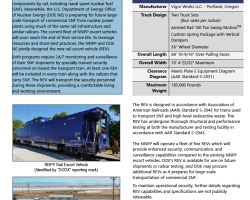
The U.S. Navy’s Naval Nuclear Propulsion Program (NNPP) transports classified, high-value U.S. Navy ship components by rail, including naval spent nuclear fuel (SNF). Meanwhile, the U.S. Department of Energy Office of Nuclear Energy (DOE NE)
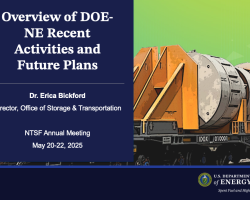
This presentation provides an overview of the DOE-NE recent activities and future plans given by Dr. Erica Bickford, Director, Office of Storage & Transportation at the NTSF Annual Meeting May 20-22, 2025.
Research project started in 2014 as a collaboration between DOE and the Electric Power Research Institute (EPRI) to support safe storage of spent nuclear fuel (SNF).
This interface control document (ICD) identifies, manages and controls the transportation system interactions between the Atlas railcar transportation equipment and external activities including vendor-supplied high-level radioactive material (HLRM) transportation casks and cradles. The term HLRM was established by Association of American Railroads (AAR). HLRM includes both spent nuclear fuel and high-level waste.
This report fulfills the M3 milestone M3SF-23PN0203020614, “Updated NPP Site Evaluation Report (2).” This report is an update of the 2021 report Nuclear Power Plant Infrastructure Evaluations for Removal of Spent Nuclear Fuel and includes expansion of the site evaluations to include operating nuclear power plant (NPP) sites and to incorporate updated site inventory data. Figures that include the number of spent nuclear fuel (SNF) assemblies and metric tons heavy metal (MTHM) in a single figure have also been added to the report.
The US Department of Energy (DOE) has since established the IWM, which builds on the work begun by NFST, to develop an integrated waste management system for spent nuclear fuel (SNF)a, including the development of a large-scale transportation system for the safe transport of SNF to storage or disposal facilities.
U.S. Department of Energy Office of Nuclear Energy
Publication Date
This report was developed as part of a knowledge management effort to document past U.S. Department of Energy (DOE) activities related to spent nuclear fuel (SNF) and high-level radioactive waste (HLW) transportation, storage, and disposal, including policy considerations, and to serve as an information resource in the ongoing planning for an integrated waste management program.
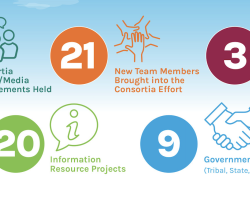
Consent-based siting consortia support DOE's efforts to facilitate inclusive community engagement and elicit public feedback on consent-based siting, management of spent nuclear fuel, and federal consolidated interim storage. The 12 awardees are comprised of various organizations to help reach communities across the country and remove barriers to participate in DOE's consent-based siting process.Awardees have made significant progress in carrying out community engagement activities and providing direct grants to communities wanting to learn more.
The U.S. Department of Energy (DOE) has established a Tribal Collaboration Initiative (TCI) that will ensure federally recognized Tribes have direct and meaningful input into DOE’s consent-based siting (CBS) process for one or more federal consolidated interim storage facilities (CISFs). Establishing a TCI ensures federally recognized Tribal interests and concerns are directly communicated and accurately represented to DOE, as the agency continues developing the siting process.
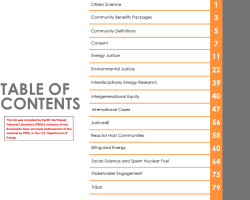
This spreadsheet provides a list of documents that national laboratory staff found through a search of the literature on social and behavioral science and environmental justice issues related to spent nuclear fuel and nuclear waste. The review was conducted from 2022 to mid-2023. It sorts the references into themes identified in the table of contents. Papers that fit more than one theme may be listed in more than one section.
This is the presentation from January 8, 2025 webinar provided by Gerard Jackson, U.D. Department of Energy, Office of Nuclear Energy, and Miriam Juckett, Pacific Northwest National Laboratory.
In this sixth installment of the U.S. Department of Energy’s (DOE's) consent-based siting webinar series, DOE officials discuss consent-based siting progress and answer questions related to the federal consolidated interim storage of spent nuclear fuel. The questions are drawn from public feedback received during previous webinars, from social science research, and from inquiries sent to DOE email inboxes.
In this fifth installment of the U.S. Department of Energy’s (DOE's) consent-based siting webinar series, a roundtable of panelists reflect on how to scale-up, re-think, or broaden the national dialogue on spent nuclear fuel management. Joining the discussion are journalists, energy policy experts, social media influencers, advertising specialists, a documentary filmmaker, members of communities currently hosting spent nuclear fuel facilities, and more.
May 25, 2024 webinar hosted by the U.S. Department of Energy Consent-Based Siting Consortia. The facilitated discussion talks about what it takes—and what it means—to successfully site a facility. Discussions include guests representing communities, industry, academia, and government who have real-world experience with hosting or siting a variety of facilities in the United States and abroad.
The U.S. Department of Energy and its Consent-Based Siting Consortia hear about inclusive public engagement from panelists representing nonprofits, professional societies, and other national, regional, and State groups.
Consent-Based Siting Consortia Kickoff webinar held July 25, 2023 in Washington, D.C. This video was edited to address technical glitches during the broadcast and recording of the webinar. The original recording can be requested by emailing consentbasedsiting@hq.doe.gov.https://www.youtube.com/watch?v=1ddoJDWNlxA
The U.S. Department of Energy’s (DOE) Office of Energy Justice and Equity will host its third Justice Week. The goal of Justice Week is to share best practices, highlight successes, and identify continued challenge areas or areas of growth.
North Central Regional Center for Rural Development
Publication Date
Processes for siting clean energy technologies and spent nuclear fuel management facilities can impact rural communities–creating new economic opportunities, inspiring cross-sectoral partnerships, altering regional land and resource use, and reshaping local perceptions of risk. In this webinar, Dr. Vincent Ialenti, Scientist, U.S. Department of Energy’s Consent-Based Siting Team, will discuss federal efforts to make people and communities central to siting one or more federal consolidated interim storage facilities for managing the nation’s spent nuclear fuel. Dr.
Consent-based siting consortia support DOE's efforts to facilitate inclusive community engagement and elicit public feedback on consent-based siting, management of spent nuclear fuel, and federal consolidated interim storage. The 12 awardees are comprised of various organizations to help reach communities across the country and remove barriers to participate in DOE's consent-based siting process.Awardees have made significant progress in carrying out community engagement activities and providing direct grants to communities wanting to learn more.
The U.S. Department of Energy (DOE) is developing special railcars for future large-scale DOE transport of spent nuclear fuel (SNF) from nuclear power plants. Designs include new buffer railcars, the Atlas railcar (to transport SNF containers), and a new escort railcar for security personnel that was developed in collaboration with the U.S. Navy. In May 2024, the Atlas Railcar was officially approved under AAR’s S-2043 standard, which is specific to railcars used to transport high level radioactive material such as SNF.
This is a Request for Information (RFI)/Sources Sought Notice (SSN). The U.S. Department of Energy Office of Nuclear Energy (DOE-NE) is considering options for conducting a Package Performance Demonstration (PPD) to help build public trust and confidence in the safety of spent nuclear fuel (SNF) transportation casks and SNF transportation by rail, heavy-haul truck, and barge by demonstrating the ability of a SNF transportation cask to withstand hypothetical accident test conditions set forth in Title 10 of the Code of Federal Regulations Part 71 (10 CFR Part 71).
This is a DOE communications resource developed to facilitate the Consent-based Siting Consortia’s public engagements. It contains information about - and context around – sixty-seven terms that commonly arise in conversations about federal consolidated interim storage and consent-based siting processes. The descriptions of terms are expressed with limited use of technical jargon.
Disclaimer: Note that this page contains links to external sites. When
leaving the CURIE site, please note that the U.S. Department of Energy and Pacific Northwest National Laboratory
do not control or endorse the content or ads on these sites.